
An 18th is the one birthday party where the guest of honour is legally an adult and half their friends aren’t. That single fact drives almost every decision, and it’s the thing parents and venues most often fail to discuss properly before a deposit changes hands.
Get it agreed in advance and the evening is straightforward. Leave it vague and you end up having the conversation at the door, in front of a hundred teenagers, with a member of door staff who is entirely within their rights to turn people away.
Here’s what to settle before you book.
The mixed-age question comes first
Your child has turned eighteen. A good number of their school year haven’t, and some won’t for months. Some of their friends will be sixteen. This is normal for an 18th, and it is the first thing to raise with any venue hire in Luton — before the date, before the price.
Ask directly: Can under-18s attend this event at all?
The answer depends on the venue’s premises licence, which may carry conditions about under-18s on site, particularly after certain hours. It is not a matter of the venue’s preference or how much you’re spending. Some venues can admit under-18s at a private function until a set time. Some can’t admit them at all. Some can, but only with conditions attached.
If a venue is vague on this, treat it as a warning sign. A venue that knows its licence will answer in one sentence.
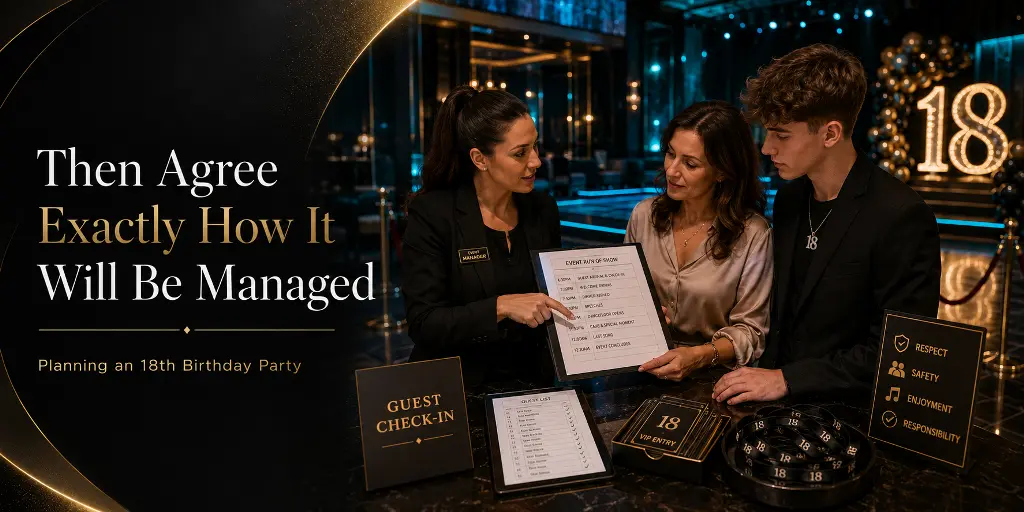
Then agree exactly how it will be managed
Assuming under-18s can attend, you need a written arrangement covering the practical mechanics. All of this should be settled at booking, not on the night.
Identification: Which forms of ID are accepted, and will everyone be asked or only those who look young? Most venues operate Challenge 25, meaning anyone appearing under 25 is asked to prove they’re over 18. Tell your guests this in advance — a passport or provisional licence is not something people carry by habit at that age, and photos of ID are not accepted.
How under-18s are identified on the night: Wristbands are the standard approach: different colours for over- and under-18s, applied at the door. Agree who supplies them and who applies them.
The bar arrangement: Be clear with yourself here. It is an offence to sell alcohol to someone under 18, and it’s also an offence for an adult to buy it on their behalf. That includes you, and it includes the older siblings and the eighteen-year-olds buying rounds for their year group. A venue’s licence — and a member of staff’s personal licence — is at risk if this happens on their premises, which is why door staff take it seriously.
Many parents avoid the issue entirely by running the event as a soft drinks bar for a mixed-age party, or by having no bar service until under-18s have left. Both are cleaner than trying to police a live bar full of seventeen-year-olds. Ask the venue what they’d recommend, because they’ve seen it go wrong before.
A leaving time for under-18s, if one applies: If the licence requires under-18s to leave at a particular hour, everyone needs to know that hour when the invitation goes out, not at half nine when nobody has a lift.
Door staff: How many, who’s paying, and what’s their brief? For a party of this type, security is usually not optional, and it’s better for everyone that it’s there. Agree the cost up front — it’s a line item that surprises people.
Adult supervision: How many adults will be present, and are they staying for the whole evening? Your child will probably lobby hard against this. The venue will almost certainly require it. The venue wins that argument, and it should.
Control the guest list
The 18th birthday party that goes badly wrong is almost always the one where the guest list stopped being a list.
Do not let the event be posted publicly on social media. An open invitation, or one that gets screenshotted and shared, is how a party for eighty becomes a crowd of two hundred outside a venue that can hold ninety. This has happened enough times that most venues will ask about it.
Use a closed group or direct invitations, give the venue a guest list and a final number, and agree what happens with people who turn up not on it. A named-list door policy is entirely normal for a private function and takes the decision away from your child, who will find it much easier to say “the venue won’t let me” than “no”.
The practical arrangements
Timing: An earlier start and finish suits an 18th better than a late one, particularly with a mixed-age crowd and parents doing pickups. Agree the finish time and put it on the invitation.
Food: Substantial food, served reasonably early, improves this kind of event more than anything else you’ll spend money on. It slows everything down, gives people something to do, and means nobody is running on empty.
Music: A DJ or a playlist your child has put together. If it’s the latter, check the venue’s equipment and how you connect to it before the night, not during it.
Getting home: For a group this age, this is the part that actually matters. Agree the finish time early enough that public transport still runs, or organise pickups in advance. Have a plan for anyone who becomes unwell, and make sure at least one adult present isn’t drinking and can drive. A town centre venue near a station makes all of this considerably easier than somewhere that requires everyone to arrange a lift.
Deposit and damage: Ask what the deposit covers, what would be deducted for, and when it’s returned. Get it in writing. This is a normal question and any venue will answer it.
What to ask on the viewing
Take this list with you:
- Can under-18s attend a private function here, and until what time?
- What ID do you accept, and do you operate Challenge 25?
- How do you distinguish over- and under-18s on the night?
- What bar arrangements do you recommend for a mixed-age party?
- How many door staff will this event need, and what’s the cost?
- How many adults do you require to be present?
- Will the space be exclusively ours?
- Can we operate a named guest list at the door?
- What’s the finish time, and can we start earlier?
- What’s the deposit, and what would be withheld for?
Frequently asked questions
Can 16 and 17-year-olds attend an 18th birthday party at a licensed venue?
Often yes, but it depends entirely on that venue’s premises licence and any conditions attached to it. Ask the specific venue rather than assuming, since the answer varies between premises in the same town.
Who is responsible for making sure under-18s don’t drink?
Everyone involved, and the consequences fall hardest on the venue. It’s an offence to sell alcohol to an under-18 or to buy it for them. Agreeing the bar arrangement in advance is far easier than managing it live.
Do we need security?
For a party of this size and age group, almost certainly, and most venues will require it. It protects your child and their friends as much as the premises.
Should parents stay for the whole evening?
Most venues will insist on adult supervision throughout, and it’s the right call regardless. Agree in advance how many adults and for how long.
How far ahead should we book?
Six to eight weeks is usually comfortable for most of the year. Summer, and the weeks after exam results, get busy — allow longer.
The short version: Settle the under-18 question before anything else, agree ID, wristbands, bar arrangements, door staff and supervision in writing, keep the guest list closed, and plan how everyone gets home before you plan anything else.
If you’re looking at options locally, After Dark is a birthday party venue in Luton in the town centre, close to the station, and the team can talk through what’s possible for a mixed-age event and arrange a viewing.
This article is general guidance rather than legal advice. Licensing conditions vary between premises — always confirm the specifics with the venue you’re booking.
Written by the team at After Dark Nightclub, a nightclub and private venue for hire on Upper George Street in central Luton, hosting private celebrations, birthdays and corporate events.